
Drafting Jacket and Coat Foundation
Preliminary steps
In order to make patterns for jackets or coats, a foundation must first he made for the front, back and sleeve. this can be accomplished quite simply by using the following steps:
1.draft the Fitted waist foundation
2.after completing the draft of the front and back, use it as a guide to draft the dress foundation [hip length]
3.finally, draft the dress sleeve foundation
4.these are the preliminary steps necessary before making the jacket or coat foundations
The jacket foundation
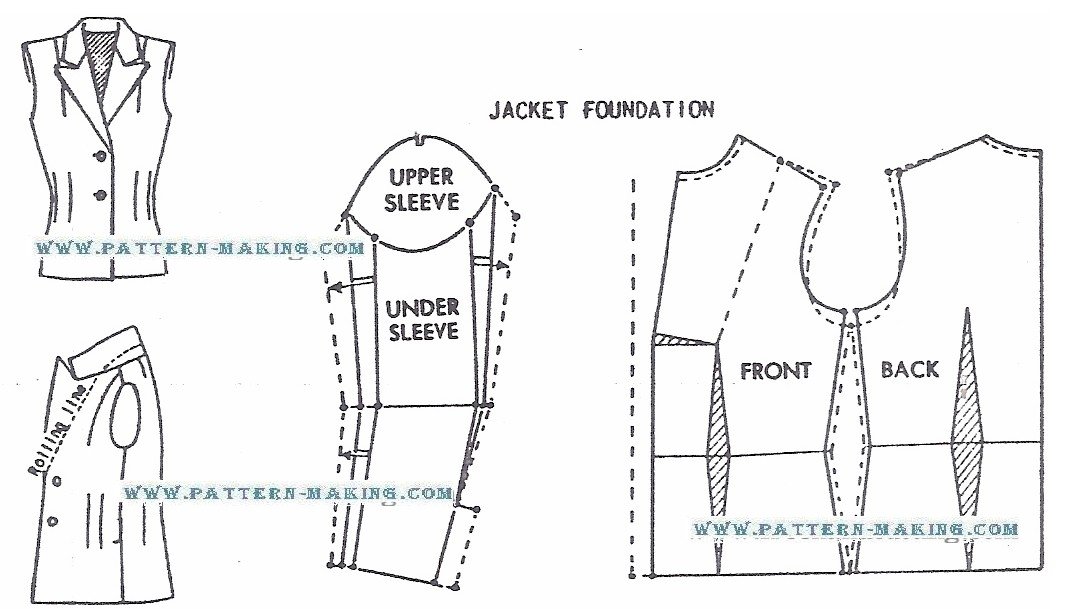
All jackets which are worn over a blouse or dress require extra ease allowance around bust, waist, hip, neck and arm. by lowering the neck line 1/8”, this will automatically increase the neck edge to the correct size [about 1/2″ larger than dress neck edge]. the armhole must be lowered at least 1/2″ to give the necessary comfort when jacket is worn over blouse or dress. sleeve should be made about 1” larger around muscle and elbow and about 1/2″ longer than dress sleeve, measuring from cap to wrist.
The coat foundation
Coats should be made large enough so that when worn over a dress it will fit comfortably and at the same time, represent the correct size. therefore, the ease allowance around the body and arm, and the depth of armhole, should be proportionately greater than that of the jacket foundation. the method as shown on the page
Jacket with notch collar
indicates the minimum ease allowance which is suitable for the fitted coat, such as the reefer or princess coat. the box-coat, however, requires extra ease around bust and hip, and often a slightly deeper armhole. this type of coat can be worn over a suit.




Comments are closed.